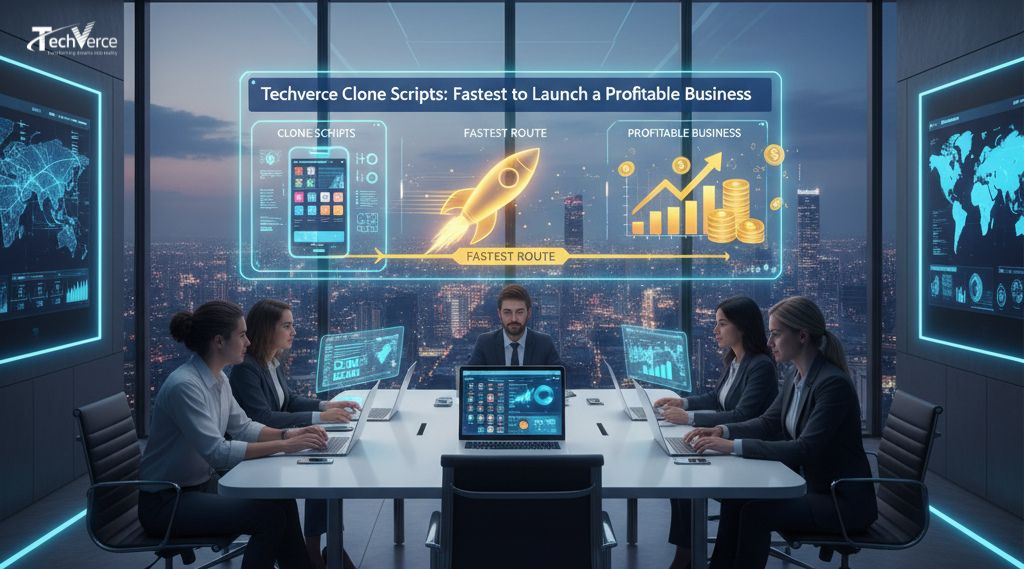
Techverce Clone Scripts: Fastest Route to Launch a Profitable Business
29 Dec, 2025


Are clone apps legal in 2025? Learn everything about app clone legality, intellectual property rights, and ethical app development. Discover how Techverce’s clone app solutions ensure full compliance with copyright and trademark laws. Understand the difference between legal clone scripts and illegal copycats, the importance of unique UI/UX, and how startups can use clone app development safely to build successful platforms like Uber, Amazon, or Netflix without infringing copyrights. Explore a detailed guide on clone script licensing, customization, and intellectual ownership to make informed decisions for your business.
In the fast-paced world of app development, entrepreneurs are constantly looking for faster and more cost-effective ways to launch their ideas. This growing demand has given rise to clone app development — a business model that allows startups to replicate the core features of popular apps like Uber, Zomato, or Instagram and launch their own versions quickly.
However, one question keeps surfacing again and again:
“Are clone apps legal?”
At Techverce, we believe that innovation must always walk hand in hand with integrity. Understanding the legal and ethical aspects of clone apps is vital for startups planning to use ready-made clone scripts. This article explains the legality, risks, advantages, and best practices surrounding clone app development in 2025.
A clone app is a software application built to replicate the core functionality of an existing, successful app while allowing for customization and branding. Clone apps are not direct copies but re-engineered solutions designed to provide similar user experiences.
For instance:
An Uber clone replicates ride-booking features but allows new branding, pricing models, and UI.
A Swiggy clone helps restaurants and startups launch their food delivery platforms quickly.
Techverce clone scripts are built from scratch — ensuring unique codebases, customizable interfaces, and compliance with legal frameworks.
The short answer: Yes, clone apps are legal — if developed ethically and within intellectual property (IP) boundaries.
Here’s the distinction you must understand:
Legal Clone Apps: Created with original code, customized design, and unique branding. They replicate functionality, not copyrighted materials.
Illegal Clone Apps: Directly copy source code, logos, trademarks, brand identity, or copyrighted elements from the original app.
Thus, what makes a clone app illegal is not its concept — but its execution.
Functionality Cannot Be Copyrighted
Copyright laws protect expression, not ideas or functionality. So, recreating an app’s core logic (like matching riders with drivers) is legal.
Trademarks and Branding Are Protected
You cannot use the same name, logo, color scheme, or visual identity as the original app.
Original Codebase
A legitimate clone must have a completely independent codebase. Techverce ensures every clone app is coded from scratch to maintain full legality.
Licensing and Distribution Rights
Using clone scripts under valid commercial licenses ensures your ownership and distribution rights are protected.
Fact: Not true. Legal clones are built independently using unique source code and are entirely lawful when they avoid copyrighted content.
Changing a name isn’t enough. Copying UI, icons, or copyrighted content still constitutes infringement.
Not always. Some free scripts may use copyrighted material without consent. Always verify the source and license validity.
Functionalities like “ride booking” or “food delivery” are not protected — but designs, workflows, and trademarks can be.
Techverce has built its reputation by providing legally compliant clone solutions that respect both innovation and intellectual rights. Here’s how we do it:
Original Source Code – Every script is written by our developers, ensuring uniqueness.
Distinct Branding – No use of logos, trademarks, or brand-specific visuals.
Custom UI/UX – Each client receives tailored design modifications.
Ethical Licensing – We provide proper documentation and software licenses.
Legal Consultation – Our experts guide clients on intellectual property compliance.
Many startups choose clone apps not to copy, but to accelerate time-to-market and reduce development costs.
Key benefits include:
Lower Development Cost – 60–70% cheaper than custom-built apps.
Faster Launch Time – Go live in weeks, not months.
Proven Business Model – Based on market-tested logic.
Scalability – Easily customizable and upgradable.
Reduced Risk – Built on proven frameworks and workflows.
For example, launching a Techverce Uber Clone allows a taxi startup to begin operations immediately while focusing on marketing and brand differentiation.
Before launching your clone app, ensure the following steps are followed carefully:
Verify that your app’s name, icon, and branding do not infringe on any registered trademarks.
Create your own design elements — including UI colors, icons, and layouts.
Draft clear Terms of Service and Privacy Policies tailored to your business operations.
Obtain a commercial license agreement from your script provider (e.g., Techverce).
Follow data laws like GDPR or India’s Digital Personal Data Protection Act (DPDP 2023) to safeguard user privacy.
Never promote your app as an “official” version of another platform.
Ola (Clone of Uber) – Different brand, same concept, original implementation.
Swiggy & Zomato – Both food delivery models but independently built.
Flipkart & Amazon – Competing e-commerce models inspired by similar logic.
Roposo (Inspired by TikTok) – Different design, same short video concept.
Each of these companies used the clone approach ethically — building new identities while adopting proven business logic.
Techverce offers ready-made clone scripts for various industries — including:
Ride-sharing (Uber Clone, Ola Clone)
Food delivery (Zomato Clone, Swiggy Clone)
E-commerce (Amazon Clone, Flipkart Clone)
Streaming (Netflix Clone, Spotify Clone)
Dating (Tinder Clone, Bumble Clone)
Education & Learning (Udemy Clone, Coursera Clone)
Fintech (Paytm Clone, CashApp Clone)
To maintain complete compliance, follow these golden rules:
Build from scratch — never reuse source code from other apps.
Redesign the interface — avoid UI similarity.
Rename features creatively — no direct naming like “UberX” or “Zomato Partner.”
Use original assets — icons, images, and logos must be designed independently.
Stay transparent — don’t mislead users or claim false affiliations.
Partner with legal experts — review your script license and user agreements.