Techverce Clone Scripts: Fastest Route to Launch a Profitable Business
29 Dec, 2025


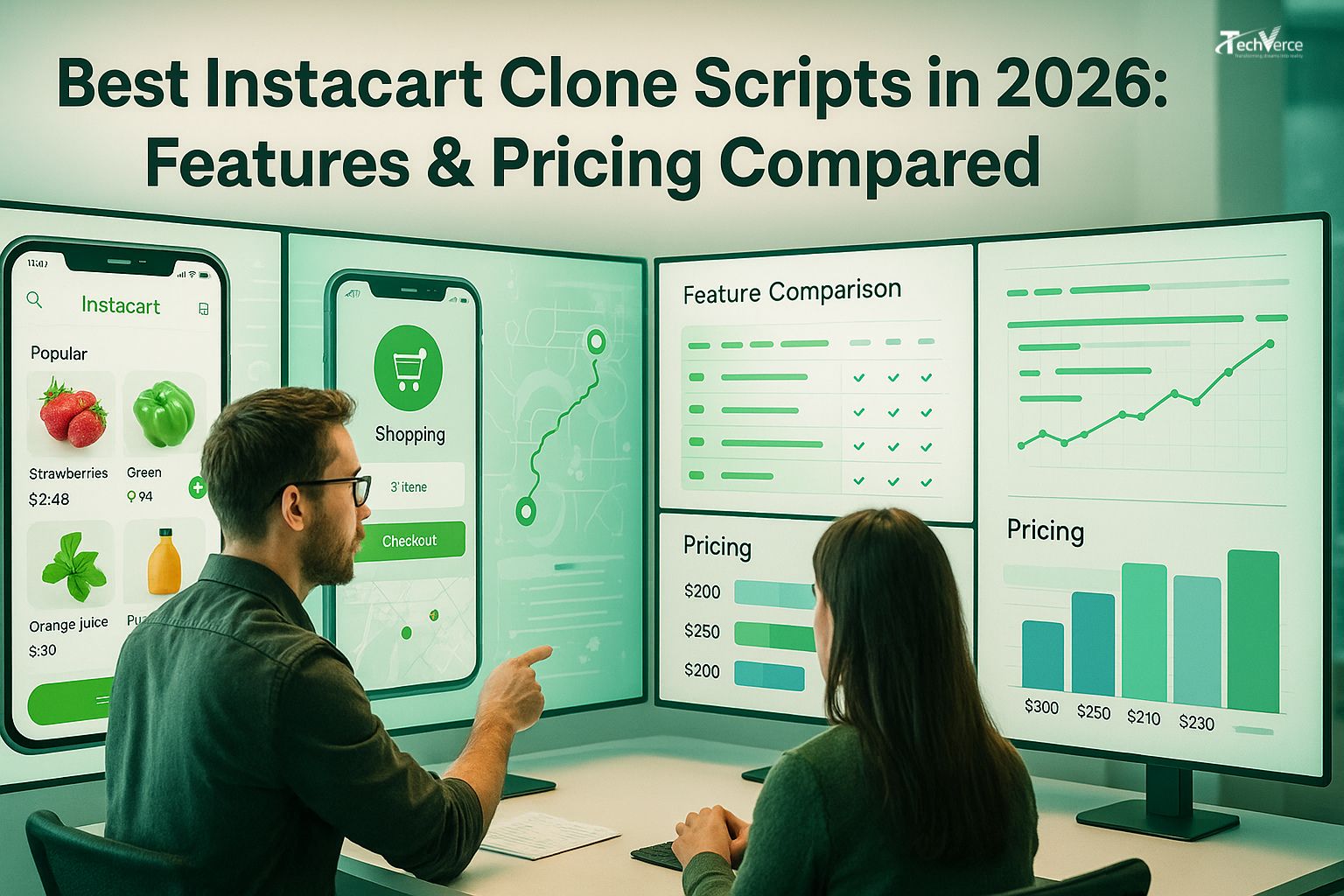
Techverce presents an in-depth guide to the best Instacart clone scripts in 2026, comparing Instacart clone features, Instacart clone pricing, and practical deployment strategies for entrepreneurs and enterprises seeking a grocery delivery app clone.
The online grocery delivery market has matured rapidly, and entrepreneurs seeking to enter this space need pragmatic, fast-to-market solutions. Techverce presents an authoritative guide to the best Instacart clone scripts in 2026 — focused on essential features, realistic pricing, deployment considerations, and how to choose a solution that aligns with operational priorities. This article is written for founders, product managers, and technical leads who prefer proven models and value reliability and control. It explains what to expect from contemporary Instacart clone scripts, how to evaluate them against business objectives, and how Techverce can assist with deployment and operationalization.
An Instacart clone script accelerates time to market, reduces development overhead, and provides a tested feature set for grocery marketplace operations. For businesses aiming to capture local demand, a clone script supplies the core modules—customer storefront, store management, shopper app, delivery logistics, and an administrative console—without reinventing foundational workflows. Market signals show sustained growth in online grocery and delivery services, making a structured, conservative approach an attractive option for capital-efficient teams. A vetted Instacart clone script allows teams to focus on merchant acquisition, shopper quality, and local marketing rather than rebuilding standard commerce flows.
A dependable Instacart clone script in 2026 must include a complete suite of features across four perspectives: customer, shopper, store, and admin. Typical, non-negotiable modules include:
Customer app and responsive web storefront with product catalog, smart search, filters, multi-store cart, schedules for same-day or timed delivery, promo and coupon management, and multiple secure payment options.
Shopper app for task acceptance, in-app communication, item substitution handling, proof of delivery, and route optimization.
Store management dashboard covering inventory synchronization, catalog control, order queueing, custom pricing, and fulfillment status updates.
Admin panel with multi-tenant controls, commission settings, real-time analytics, dispute resolution, user and merchant verification, and role-based access control.
Additionally, enterprise-ready scripts provide API-first design, webhooks for third-party integrations (payment gateways, SMS/email, mapping and routing), and modular microservices that enable phased scaling. Real-time tracking and robust notification systems remain critical for customer trust and operational predictability.
By 2026, stability and compliance are baseline expectations. A professional Instacart clone script should use mature stacks (for example, Node.js or Laravel backends with PostgreSQL or MongoDB, and React Native or Flutter for mobile) and follow secure development life cycle practices. Encryption for data at rest and in transit, tokenized payment flows (PCI-DSS compliance for card data), secure authentication (multi-factor where required), and audit logging are essential. Scripts offering automated testing, CI/CD pipelines, and documented deployment procedures materially reduce operational risk. For regulated markets, the chosen script should permit integration with local KYC tools and provide configurable verification flows for restricted items.
Several advanced capabilities justify higher price points and faster ROI:
Inventory intelligence and near-real-time stock sync with grocery POS systems.
Predictive restocking notifications and demand forecasting for popular SKUs.
Advanced route optimization that minimizes delivery time and fuel consumption for multi-stop trips.
Multi-store marketplace support that handles complex commissions, settlement cycles, and vendor catalogs.
Native support for quick-commerce (ultra-fast delivery under 30 minutes) in addition to standard windows.
These differentiators materially reduce operational friction and customer churn for businesses that scale beyond a single city.
Pricing for Instacart clone scripts varies by licensing model, feature set, and service levels. Common commercial models include one-time license fees, SaaS subscriptions, and white-label arrangements with customization retainers. Based on market signals and supplier disclosures, realistic price bands in 2026 are:
Entry-level clone scripts (basic storefront, shopper app, admin panel): USD 1,500–4,000 one-time, or USD 49–199/month SaaS for hosted offerings.
Mid-tier solutions (extended features, custom branding, basic integrations): USD 4,000–15,000 one-time, or USD 199–599/month SaaS.
Enterprise-grade platforms (full multi-vendor marketplace, advanced routing, POS integration, SLA support): USD 15,000–80,000+ one-time, or custom enterprise SaaS pricing with per-order or revenue-share components.
These ranges exclude recurring costs such as cloud infrastructure, payment gateway fees, SMS/email providers, and app store publication charges. Development, customization, and local regulatory compliance can add meaningful expense; prudent budgeting sets aside 20–40% of initial license cost for first-year operational adjustments.
When evaluating clone scripts, create a scoring matrix that weights priorities against business needs. Typical weighted factors include:
Core feature completeness (25%): Does the script provide a full customer, shopper, store, and admin experience out of the box?
Scalability and architecture (20%): Is the code modular, documented, and cloud-native compatible?
Security & compliance (15%): Are payment flows tokenized and compliant with local regulations?
Customization and extensibility (15%): Ease of adjusting flows, UI, and integrations.
Cost of ownership (15%): License vs SaaS, plus expected operational costs.
Post-sale support and documentation (10%): SLA, bug fixes, and upgrade policies.
Using a clear matrix avoids emotional choices and supports a conservative, business-focused decision process.
Deployment choices influence both cost and time to revenue. A hosted SaaS clone reduces infrastructure overhead and accelerates time to first order; however, it can limit customization and data ownership. One-time license models with self-hosting provide full control and lower recurring fees but demand DevOps capability and operational discipline. For enterprises, hybrid models that combine a managed cloud with optional on-premise connectors are common. Techverce recommends staged rollouts: pilot in one micro-market, stabilize merchant and shopper onboarding workflows, then expand regionally once KPIs validate the unit economics.
Beyond software, successful grocery marketplaces succeed by operational rigor. Key operational elements include:
Shopper recruitment and verification protocols, with training materials and clear substitution policies.
Partner onboarding for local stores, including standard catalog templates to reduce manual entry.
Logistics protocols for multi-stop deliveries, batching, and contactless handoffs.
Customer service processes with SLAs for refunds, returns, and quality disputes.
Techverce advises creating a playbook that documents these procedures and integrates them into the admin dashboard to maintain consistent operational standards.
Grocery commerce is local by nature. Scripts that support currency, language, local tax rules, and regional payment methods accelerate adoption. Additionally, grocery-specific regulations — for example, age-restricted sales for alcohol or controlled substances — require configurable product flags and verification workflows. Always verify that your chosen script supports flexible tax rules, invoicing formats, and compliance logging to simplify audits and merchant onboarding.
A conservative pilot using a mid-tier Instacart clone script typically shows these early indicators within the first six months:
Time to first order: 7–21 days post-launch with a focused merchant and shopper onboarding campaign.
Break-even on initial software investment: 6–12 months in dense urban markets with effective promotional budgets and controlled commission rates.
Operational KPIs to monitor: average order value (AOV), items per order, delivery time, shopper acceptance rate, and order cancellation rate.
These projections assume disciplined marketing, efficient shopper networks, and a high-quality SKU catalog.
Ensure the clone script either includes or supports simple integration with:
Payment gateways with local coverage.
SMS and transactional email providers.
Mapping and routing APIs for real-time tracking and ETA calculations.
Analytics and BI connectors for revenue, churn, and cohort analysis.
POS and inventory systems for larger retail partners.
Integration simplicity reduces manual reconciliation and accelerates merchant adoption.
Select a vendor that provides clear SLAs, transparent upgrade paths, source code escrow (for licensed deployments), and documented data export procedures. Negotiate clauses for bug-fix turnaround, security patching, and performance targets. For mission-critical grocery operations, insist on a staging environment, load testing results, and a clearly defined handover for customizations.
Techverce supplies curated Instacart clone solutions that balance conservative engineering practices with pragmatic features. Our offerings emphasize clear upgrade paths, documentation for operational playbooks, and optional managed hosting to suit enterprises that value control and stability. Techverce supports on-premise connectors for sensitive integrations and provides post-sale training packages for operational teams to ensure a consistent customer experience.
Q: Can a clone script handle multi-vendor marketplaces?
A: Yes. Mature Instacart clone scripts support multi-vendor architectures with per-vendor catalogs, commission management, and settlement cycles. When deploying a multi-vendor marketplace, prioritize reconciliation features and vendor reporting to avoid disputes and maintain supplier trust.
Q: How much customization is safe without breaking future upgrades?
A: Limit invasive core changes to avoid upgrade debt. Prefer theme-level UI modifications, configurable business rules, and plugin-style extensions. If deep domain-specific workflows are necessary, negotiate a documented upgrade and merge plan with the vendor to guarantee patch compatibility over time.
Q: Is white-labeling included in typical licenses?
A: Many vendors include white-label options — brandable UI, custom domain, and app store publishing support — as part of mid-tier or enterprise packages. Verify whether white-label rights extend to source code and whether there are restrictions for resale or multi-region deployments.
Q: What is the typical time to customize and launch?
A: For entry-level deployments, expect a focused launch in 2–6 weeks. Mid-tier customizations and integrations commonly extend the timeline to 6–12 weeks. Enterprise rollouts with extensive integrations or regulatory requirements can require 3–6 months of engineering and operational preparation.
Maintain a separate staging environment to validate patches and customizations before production deployment.
Use database migration tools and semantic versioning to keep schema changes manageable.
Document all bespoke changes and implement feature flags to allow safe toggling of experimental functionality.
Insist on automated backups and a clear rollback plan as part of the operational SLA.
Request a feature matrix and a demo focused on the merchant onboarding flow and shopper experience.
Obtain sample load-testing results and clarify expected concurrent users per pricing tier.
Confirm the cadence for security updates and whether penetration testing is included.
Ask for references or anonymized case studies showing successful deployments in similar markets.
Clarify all recurring fees and third-party costs that will be billed separately.
AOV (Average Order Value): Average revenue per completed order.
SKU: Stock Keeping Unit; unique identifier for a product.
POS: Point of Sale system used by physical stores to manage inventory and sales.
SLA: Service Level Agreement; contractual performance guarantees.
Quick-commerce: Ultra-fast delivery model focused on sub-30-minute fulfillment windows.
Start conservatively: choose a solution that offers a complete core feature set and phased optional upgrades. Rapid feature creep increases operational risk.
Measure early and iterate: instrument your platform from day one for AOV, shopper efficiency, and order lifecycle metrics. Data-driven iteration reduces churn and optimizes commission strategies.
Protect the business: insist on contractual security guarantees, source code protections for licensed deployments, and an exportable data format to preserve future flexibility.
Budget responsibly: include cloud, payment, messaging, and team costs in first-year financial forecasts.
Leverage Techverce expertise: work with a partner that emphasizes operational playbooks, conservative engineering, and documented upgrade paths to ensure long-term stability.
Techverce provides tailored Instacart clone solutions, managed deployment options, and operational support packages designed for conservative, risk-aware enterprises. Contact Techverce to request a demo, receive a tailored pricing estimate, or obtain a deployment playbook for your market.