Techverce Clone Scripts: Fastest Route to Launch a Profitable Business
29 Dec, 2025


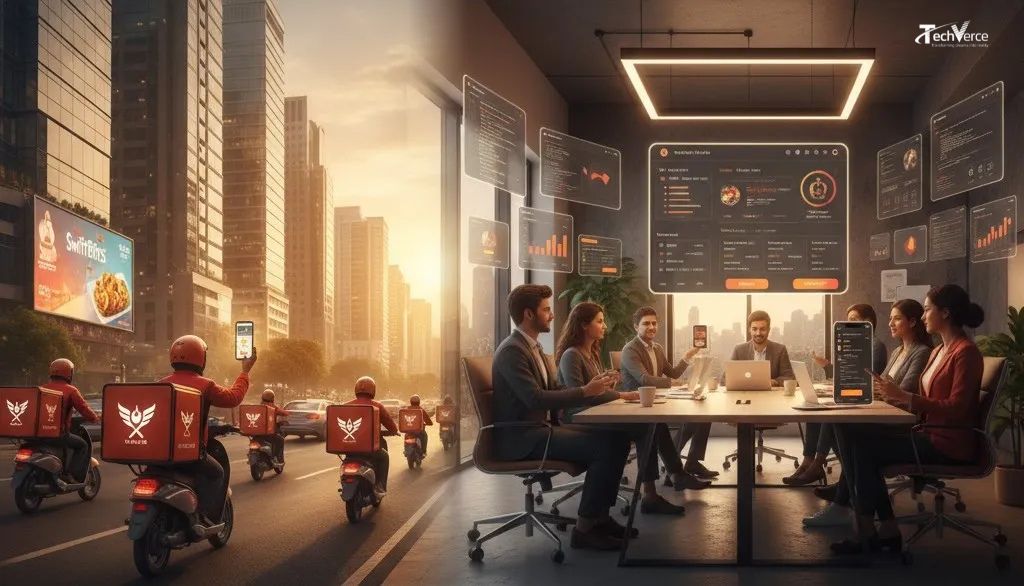
Build your own food delivery empire with a Swiggy/Zomato clone solution. Discover how to launch a white-label on-demand food ordering app, explore revenue models, key features, cost-saving strategies and marketing tips. Get your food delivery startup off the ground faster with clone technology.
In the current digital age, the food delivery sector presents one of the most compelling opportunities for entrepreneurs with vision. With the right strategy, your company—Techverce—can capitalise on this trend by offering a white-label food delivery platform, modelled after giants like Swiggy and Zomato. In this article, we explore how you can build your own food-delivery empire leveraging a clone solution, examine the key features, monetisation strategies, market dynamics and best practices to ensure success.
The food delivery market continues to grow at a robust pace. For instance, global on-demand food delivery app usage is projected to rise significantly as users increasingly prefer convenience and home delivery.
For India specifically, Zomato forecasts its food delivery business to grow at about 30 % annually over the next five years.
Why is this opportunity particularly strong?
Consumer behaviour has shifted: more people order from mobile apps rather than dine-in.
Restaurant and food-service operators are open to partnering with platforms to access broader audiences.
Technology costs have dropped and ready-made clone solutions expedite market entry.
For your company Techverce, choosing to develop or offer a food delivery clone script means you can tap into this rising demand, reduce development time and compete quickly.
A clone script in the context of food-delivery means a pre-built solution that replicates the core functionalities of established platforms—restaurant discovery, order placement, payment processing, delivery tracking, and vendor dashboards. As explained by industry analyses, a food delivery clone app allows businesses to launch their own platform without starting from scratch.
In practical terms:
White-label branding: You can re-brand the app with your own name and brand identity.
Multi-panel architecture: There is typically an app for customers, an app for delivery agents (drivers), an app or panel for restaurants and an admin dashboard for the platform owner.
Feature-rich baseline: The clone includes essential features such as real-time tracking, push notifications, order history, user reviews, payment gateway integration.
Customisation: Although based on a template, you can tweak features, UI/UX and add modules unique to your business plan.
For Techverce, offering a food-delivery clone means you can position your product as “launch your food-delivery app in weeks, not months” and appeal to entrepreneurs who want to enter the market quickly.
To compete and provide value, your food-delivery clone must integrate features that satisfy modern user expectations and business needs. Below are critical features to include:
Easy onboarding and login (email, phone, social login)
Browse restaurants or cuisines, menu display with images and descriptions
Search and filter (cuisine type, ratings, delivery time, offers)
Order placement, customisation of items, add-ons
Real-time tracking of delivery: map view, driver profile, ETA
Payment gateway integration: cards, wallets, UPI (for India), cash on delivery
Ratings & reviews of restaurants and delivery service
Offers, discounts, loyalty rewards
Dashboard showing order-inflow, revenue, menu management
Accept/decline or auto-accept orders
Set delivery areas, minimum order value, custom delivery fees
Manage preparation times, kitchen workflow, status updates
Analytics: popular items, customer feedback, peak hours
Agent login and verification
Accept/decline assignments, see pickup and drop-off details
Navigation to restaurant and to customer, order status updates
Earnings dashboard: per-delivery fee, incentives, ratings
Multi-vendor management: add or reject restaurants
Commission management: set platform commission for each partner
Pricing and fee settings: delivery fee, surge pricing, subscription models
Reports and analytics: orders, revenue, customer acquisition, geographic heat-maps
Push notifications, campaign management, customer support
Security and role-based access
Including these features ensures your clone solution is not just a bare-minimum app, but a complete platform capable of scaling and monetising effectively.
Part of any successful food-delivery business is having well-defined revenue streams. With your clone platform, here are the monetisation models you should support:
Commission from restaurants: The platform charges a percentage of each order placed via your app. This is a primary revenue stream.
Delivery fee from customer: Charge customers a delivery fee based on distance, order size, or surge hours.
Subscription plans for restaurants: Offer premium listings, featured placement, analytics access for a monthly or annual fee.
Promotions & advertising: Restaurants or brands pay for special featured slots, banner ads, or push-notification promotions.
Surge pricing / peak hour fees: During high-demand hours, you may raise the delivery fee or offer premium service at extra cost.
Service fees / convenience fees: Small charges for processing payments, late order management, etc.
White-label licensing: If you sell your clone script, other entrepreneurs pay a one-time fee + customisation/maintenance costs.
By building your platform with these monetisation models in mind, you can ensure that your business scales not only in terms of orders but also profitability.
One of the major advantages of offering clone solutions via Techverce is the reduction in time-to-market and cost vs building an app from scratch. Several sources highlight the cost effectiveness of clone apps:
A food delivery app like a Swiggy clone can be built using white-label solutions, which significantly reduce development time and cost.
Development cost breakdowns show that full custom apps (from scratch) may cost tens of thousands of dollars—whereas clone scripts allow smaller investment.
For example:
Basic or MVP food-delivery apps may cost USD 15,000–30,000.
With more advanced features (admin dashboards, GPS tracking, multiple platforms), cost may rise to USD 50,000–100,000.
Using a ready-made clone, you might launch in weeks rather than several months.
As Techverce, you can emphasise this cost and time advantage to your clients: “Launch your food-delivery app like Swiggy/Zomato in weeks, cost-effectively.”
When you position your offering, keep in mind both your target market (entrepreneurs, restaurant chains, delivery networks) and your unique value proposition. Here are points to emphasise:
Rapid deployment: Unlike building everything from scratch, your clone script accelerates time-to-market.
Custom branding & localisation: Adjust colours, logos, languages (for local markets), payment gateways suited to region (for India: UPI, Razorpay).
Scalability: Platform built to handle multi-restaurant, multi-city operations, with analytics and growth tracking.
Monetisation ready: Pre-built revenue models (commission, delivery fees, subscriptions) out of the box.
Support & maintenance: Because it’s your product, you can offer support, updates, hosting, custom modules as value-adds.
Cost-effective: Show cost comparisons between custom build vs clone and how clients save money and minimise risk.
Market expertise: Demonstrate understanding of food-delivery market trends, consumer behaviour, vendor needs.
Your blog and content strategy should reflect this positioning.
Here is a suggested roadmap for launching a food-delivery empire using your clone product:
Decide your service area (city, region), type of restaurants (local small eateries, premium dining, fast-food chains), delivery mechanism (in-house fleet, third-party couriers).
Work with your development team to configure branding, UI/UX, configure payment integrations, map APIs, set local language support. Set up vendor panels, delivery-agent workflows.
Partner with restaurants in the target region, load menus, pictures, delivery zones, pricing. Create vendor incentive programmes.
Promote the app to users: social media, local SEO, referral programmes, discounts for first orders. Also attract delivery agents and staff.
Use analytics dashboards to track orders, customer acquisition cost, average order value, delivery time, repeat rate. Optimise menu offerings, vendor operations and marketing spend.
Once you succeed in one region, expand to neighbouring cities. Add additional services (grocery delivery, quick commerce) to broaden offerings.
Since your goal is to create a blog (and more broadly, content) to rank in Google, here are some targeted SEO-driven strategies:
Use high-volume keywords like: food delivery app clone, Swiggy clone script, launch food delivery platform, food ordering app white label, restaurant delivery startup etc.
Create content that answers questions: “How much does it cost to build a food delivery app?”, “What features should a food delivery app have?”, “How do I monetise a restaurant delivery app?”
Include long-tail keywords specific to region or niche: “food delivery clone India”, “local restaurant delivery app clone Pune”, “multi-restaurant ordering app for Indian market”.
Optimise meta tags, headings (H1, H2, H3) with your keywords.
Use internal linking from your blog to your product pages (Techverce’s clone solution) and case-studies.
Build backlinks: guest blog posts, partnerships with restaurant industry publications, interviews.
Create value-driven content: e.g., “5 mistakes restaurant owners make when using food delivery apps”, “How to reduce delivery time cost in your delivery app”.
Use structured data (schema.org) for articles, and if possible for your blog posts to appear as rich snippets.
Even as you build your food-delivery empire, you must be aware of risks and how to mitigate them:
High competition: Many markets already dominated by large players. Mitigate by focusing on niche regions, local cuisines, value-added service.
Logistics cost and delivery time: Delivery is expensive and time-sensitive — ensure you have efficient courier workflows, route optimisation and maybe local hubs.
Vendor churn: Restaurants may switch platforms if numbers don’t add up. Mitigate through transparent commission models, vendor support and promotional campaigns.
Technology glitches: Poor performance, crashes, payments failing damage reputation. Mitigate via robust QA, scalable infrastructure and user support.
Regulatory and labour issues: Compliance with local labour laws for delivery agents, taxes, data protection. Mitigate with legal counsel and transparent policies.
Customer retention: Acquiring users is one thing; keeping them is another. Mitigate via loyalty programmes, personalised offers, quality service.