
Techverce Clone Scripts: Fastest Route to Launch a Profitable Business
29 Dec, 2025


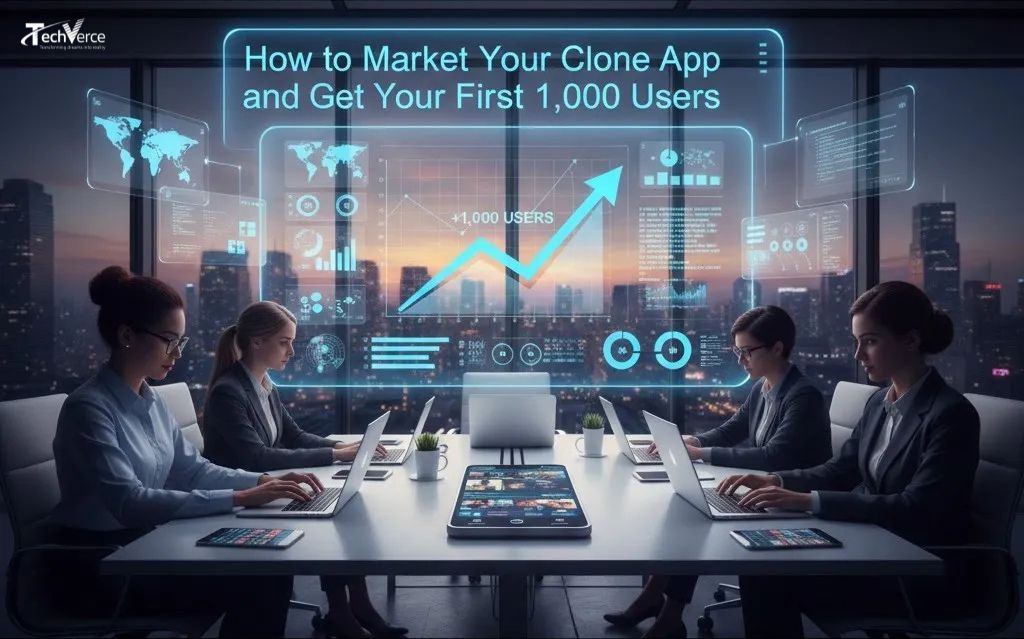
Learn how to effectively market your clone app and get your first 1,000 users with proven strategies. From defining your audience to optimizing your app store listing, executing influencer campaigns, building landing pages, leveraging content marketing and social media, and using referral programmes—this comprehensive guide walks you through each step. Discover how to combine “app marketing for clone solution”, “app user acquisition”, “launch a clone app”, and “getting first 1000 users” into a solid plan that drives downloads, engagement and retention. Whether you’re launching a travel app clone, food-delivery clone or any other clone app, you’ll find actionable tactics to outperform competitors, optimise your app store visibility, and turn your first 1,000 users into loyal ambassadors.
Launching a clone app—be it a food-delivery clone, marketplace clone, on-demand clone or any other “clone app solution”—presents both opportunity and challenge. On one hand you benefit from a proven business model. On the other, you must execute app marketing for clone solution with precision to capture your first 1,000 users and build momentum. In this article we walk you through a comprehensive, traditional yet effective path—aligned with best practice in app user acquisition and digital promotion—to reach that milestone.
Before any promotion, you must know who you are selling to and why they should choose your app-clone over others. Many apps fail simply because they did not clearly define their target user.
Segment your audience: define age, location, income, pain-points. For example: “busy city-dwellers who need ultra-fast food-delivery”, or “independent freelancers seeking a task-marketplace”.
Pain-point & benefit: What frustration does your clone app solve? Why is your version better (faster, cheaper, more localised) than existing apps or custom builds?
Unique selling proposition (USP): As a clone product you may emphasise faster launch time, lower cost, local adaptation, support and customisation.
Value-message clarity: Use your USP consistently in your marketing: “Launch your marketplace with our ready-made clone”, or “Get your food-delivery app up and running in days”.
This clarity will inform the remainder of your marketing—from landing pages to social posts to app store optimisation.
Marketing begins long before you hit ‘Publish’. Creating a foundation ensures your launch has a warm start, not a cold one. According to practical guides, apps with effective pre-launch momentum bypass many early pitfalls.
Landing page + email capture: Create a simple website or page for your clone app: explain what it does, show screenshots or demo flows, include an email signup (“Be first to download”).
Social presence: Set up social media profiles (LinkedIn, Instagram, Facebook, Twitter) relevant to your audience. Start posting updates: behind-the-scenes, development progress, countdowns.
Beta testers / early adopters: Invite a small group to test the app or signup for early access. These become your first advocates and feedback channel.
Analytics set-up: Ensure you have tracking in place (downloads, signups, sources) so you can attribute your first user acquisition properly.
PR / outreach: Prepare a short press kit or outreach email to bloggers, niche websites, influencers in your industry. Even small mentions build credibility.
By the time you launch, you already have a small “warm” audience and can kick off downloads with real momentum.
Once your clone app is live, its listing in the Google Play Store or App Store is your primary storefront. Good ASO improves visibility and conversion.
App title & keywords: Choose a descriptive title that includes a high-intent keyword (e.g., “FoodDelivery Clone – Launch your marketplace”) and optimise your description with terms your audience uses.
Compelling icon & screenshots: Visuals matter. Show benefit-oriented screenshots (“Get orders in 2 minutes”, “Real-time schedule”) rather than generic UI.
Subtitle / short description: Use this space to highlight your USP and primary reason to download.
Reviews and ratings: Encourage your early testers to leave reviews. Good ratings help ranking and trust.
Localization: If you target multiple regions (India, Middle East, SE Asia) localise your listing for each language and market.
Deep links & tracking: Use tracking parameters so you know which channels drive installs and which don’t.
Strong ASO means your clone app shows up in searches, appears in “Similar apps” lists, and converts more visitors to installers.
Reaching the first 1,000 users demands a mix of paid, owned and earned channels. According to mobile app marketing frameworks, a balanced channel mix increases chances of early success.
Referral programme: Offer incentive to early users to refer friends (discounts, premium features, credits). Word-of-mouth is powerful.
Influencer / micro-influencer campaigns: Identify small influencers in your niche whose followers match your target. They drive credible traffic.
Paid ads (smartly): Use Facebook/Instagram/Google/Play Store install ads. But start small, test creatives, track cost per install and retention.
Content marketing & SEO: Publish blog posts on your website about topics your audience searches (e.g., “How to build a food-delivery business”, “Benefits of clone apps for startups”). These keywords align with “clone app marketing”, “launch clone solution”, “first 1000 users”.
Social proof & user stories: Share testimonials from early users or beta testers. Show screenshots of orders, usage stats, feedback.
App review sites & directories: Submit your app to niche review websites and app directories. Even small features can yield dozens of downloads.
Offline / network marketing: If your clone app covers a local market, attend meetups, hand out flyers with QR code download link, partner with local businesses.
Engage communities/forums: Identify where your target audience gathers (Reddit, Facebook groups, LinkedIn groups). Participate genuinely, then introduce your app when relevant.
For example, if you are promoting a food-delivery clone app targeted at local restaurants in India, you might approach restaurants, show them how the app helps them get orders, and offer initial low-cost or free trial. Their customers then download the clone app.
Downloads are only part of the story. If users install and never open, you still haven’t built a base. According to research, many apps lose 70% of users in the first week. So:
Ensure onboarding is smooth: show value within first session.
Send push notifications / email follow-ups to re-engage.
Use referral and reward systems to keep users coming back.
Monitor metrics: Day 1 retention, Day 7 retention, active users.
Once you hit your first 1,000 users, your next step is scaling—but if you skip measurement you’ll waste resources.
Acquisition channels: Which ads/refs/influencers delivered users? At what cost?
Conversion rate: From listing impression → install → open → activation.
Retention / churn: How many users return after 1 day, 7 days, 30 days?
Lifetime value (LTV): Are users monetising (in-app purchase, subscription, ads)?
Referral rate: How many downloads come from each user?
A/B test your app listing, landing page, ad creatives.
Remove channels that cost too much for too few quality users.
Double-down on channels that deliver quality installs (i.e., high retention).
Concertedly ask your first users for feedback: What do they like/dislike? Improve your clone app accordingly.
Localise further: if the app is gaining traction in one region, create language/region versions and target similar markets.
Though you are offering a clone app, you still need to build trust and professional branding. Startups trust providers who appear credible, not simply “clone” vendors with no brand.
Brand website: Present your company (in this case your IT company) as experienced in delivering clone solutions, mention delivery timeframes, support, case-studies.
Demo & walkthrough videos: Produce short videos showing how your clone app works.
Testimonials / case studies: If you’ve worked with clients, include success stories (“Our restaurant client saw 30% more orders after launching the clone app”).
Support & updates: Demonstrate you will maintain the product, release updates, handle bugs. This reassures early adopters.
Positioning as growth partner: Emphasise you help clients get “first 1,000 users” and beyond—so you’re not just supplying an app, you’re enabling growth.
Reaching the first 1,000 users is important—but growth doesn’t stop there. For sustainable success:
Continue content marketing: Drive organic traffic via blog posts, guest posts, SEO.
Leverage referrals: Make referral part of your product’s DNA.
Expand to new markets: Localise for other geographies (languages, currencies).
Improve user engagement: Push notifications, loyalty programmes, gamification.
Offer upgrades or premium features: For clients using your clone app: add new modules, integrations, customisations, support packages.
Monitor competitor clone‐solutions: Stay ahead by offering more value, better UI, faster performance.