
Techverce Clone Scripts: Fastest Route to Launch a Profitable Business
29 Dec, 2025


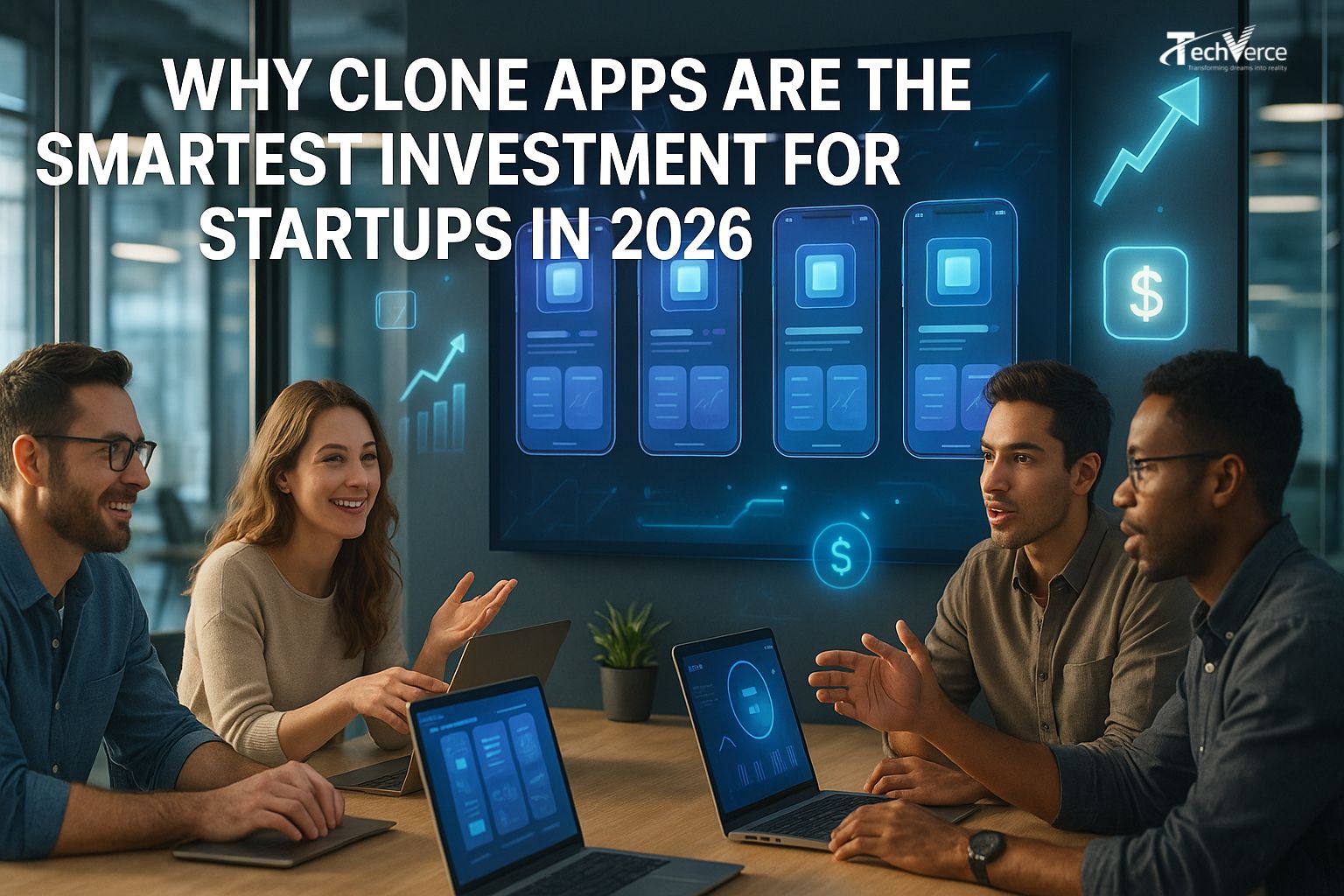
Every successful business begins with a bold idea — but execution is what sets winners apart. In a market that changes every month, startups need solutions that combine speed, quality, and adaptability. Clone apps deliver exactly that.
In today’s digital-first business era, innovation and speed determine survival. Startups often face the challenge of building powerful, feature-rich applications quickly and within limited budgets. Traditional app development can be expensive, time-consuming, and complex — a major hurdle for new entrepreneurs.
This is where clone apps have emerged as the game-changer of modern entrepreneurship.
As we step into 2026, clone apps are no longer mere replicas of popular platforms. They’ve evolved into customizable, scalable, and innovation-ready solutions that empower startups to launch faster, compete efficiently, and succeed sustainably.
In this article, we’ll explore why clone apps are the smartest investment for startups in 2026, supported by real-world benefits, market insights, and expert analysis.
A clone app is a ready-made software solution modeled after a successful existing platform such as Uber, Zomato, Amazon, or Airbnb. It replicates the core functionalities of the original app while offering the flexibility to customize branding, features, and UI as per business requirements.
For instance:
A Uber Clone App enables startups to launch a taxi booking platform with GPS tracking, payment integration, and ride management features.
An Amazon Clone App provides a complete e-commerce infrastructure with product listings, checkout, and seller dashboards.
But unlike direct copies, modern clone apps are built to be unique and customizable. They serve as a foundation, saving years of development time and cost — allowing entrepreneurs to focus on business strategy, marketing, and user experience.
The global app development industry is expected to exceed $300 billion by 2026, driven by the rapid adoption of digital platforms across sectors like logistics, healthcare, finance, and education. However, traditional development methods cannot keep up with the speed and cost-efficiency demanded by the startup ecosystem.
According to recent market insights:
More than 60% of new startups in 2025 used some form of pre-built or clone-based software.
Clone app providers like Techverce have seen a surge in demand for on-demand delivery, fintech, and marketplace clones.
Entrepreneurs are now prioritizing speed-to-market over ground-up coding, focusing instead on brand differentiation and scalability.
The data makes one thing clear — clone technology is not imitation, but evolution.
Launching a startup is a high-stakes endeavor. Every minute and every dollar counts. Here’s why clone apps are proving to be the smartest and safest investment for startups in 2026:
Building an app from scratch can take 8 to 12 months, often longer if revisions or redesigns are required.
In contrast, clone apps from providers like Techverce can be deployed in 2 to 4 weeks, depending on customization.
This dramatic reduction in time-to-launch enables startups to:
Test the market faster
Start generating revenue sooner
Stay ahead of competitors
Speed has become a decisive factor in 2026 — and clone apps deliver exactly that.
App development can cost anywhere between ₹10 lakh to ₹1 crore, depending on complexity. For startups operating on lean budgets, this is a huge burden.
Clone apps eliminate unnecessary costs by providing:
A pre-tested codebase
Built-in security modules
Integrated payment and communication systems
This reduces expenses by up to 70%, making it financially viable even for solo founders or small enterprises.
When you invest in a clone app, you are essentially adopting a business model that has already proven successful in the market.
Uber, Swiggy, Netflix, and Amazon all operate on tested revenue and user retention strategies. Clone apps mirror these foundations — providing your startup with a reliable, result-oriented blueprint.
Rather than experimenting with an untested model, startups can focus on local innovation, marketing strategies, and user experience enhancements.
Modern clone scripts are built using flexible frameworks like Laravel, Flutter, React Native, and Node.js, allowing complete customization.
Startups can modify:
Branding (logo, color scheme, name)
Features (add chatbots, AI suggestions, or loyalty programs)
User roles and dashboards
Moreover, these apps are scalable, supporting future growth without the need for complete redevelopment.
Traditional development carries a high risk of bugs, integration failures, and performance bottlenecks. Clone apps, on the other hand, are pre-tested and optimized solutions used by multiple clients across industries.
This means:
Fewer crashes
Better code stability
Simplified maintenance
Techverce, for example, ensures each clone app undergoes quality assurance, load testing, and data security audits before delivery.
The primary challenge for any startup is entering the market quickly. Clone apps remove this barrier completely.
Since most of the backend systems, APIs, and features are already integrated, your app can go live within days — giving you immediate visibility and the ability to capture customers early.
A common misconception is that clone apps limit creativity. In reality, they enable it.
Think of a clone script as a foundation stone — you don’t waste time reinventing the wheel. Instead, you innovate on top of it.
For example:
A Netflix Clone can evolve into an educational streaming platform.
A Zomato Clone can transform into a home chef delivery app.
A Fiverr Clone can become a specialized freelancing portal for coders or designers.
By starting with a proven structure, startups can focus on differentiation and user experience rather than backend development.
Many popular platforms today began as inspired clones before growing into their own successful identities.
Ola was initially modeled after Uber, but later customized its services for the Indian market, adding cash payments and auto-rickshaw options.
Zomato, inspired by Yelp, grew by integrating local delivery partnerships and AI-driven restaurant recommendations.
ShopClues and Snapdeal started as e-commerce clones, later adapting for regional audiences.
Clone apps thus provide a shortcut to success without compromising originality. They allow startups to stand on the shoulders of giants and innovate further.
In 2026, clone app development has become more technologically advanced than ever before. Companies like Techverce use the latest frameworks and best practices to deliver secure and high-performance solutions.
Frontend: React, Vue.js, Flutter
Backend: Laravel, Node.js, Django
Database: MySQL, MongoDB, Firebase
Cloud & Hosting: AWS, Google Cloud, DigitalOcean
Payments: Razorpay, Stripe, PayPal, Crypto integration
Security: Two-factor authentication, encryption, GDPR compliance
Such a robust stack ensures your startup can scale confidently and serve thousands of users simultaneously without downtime.
Launching a clone app quickly also gives startups a marketing advantage. The earlier you enter the market, the faster you can optimize for SEO, social media, and app store rankings.
Clone apps help by:
Providing pre-built SEO-friendly URLs and metadata
Allowing quick integration with analytics and ad platforms
Enabling faster testing of user engagement metrics
Techverce even provides marketing-ready app templates, so startups can begin branding and user acquisition immediately.
A question often asked is: “Are clone apps legal?”
Yes — as long as they do not copy proprietary content, design assets, or trademarks. Clone apps simply replicate functionality, not brand identity.
At Techverce, each solution is built from scratch, inspired by successful models but structured uniquely, ensuring full compliance with intellectual property laws.
The future of clone app development lies in AI-driven customization, automation, and cloud integration. By 2026, clone apps are expected to evolve into no-code platforms, where entrepreneurs can design and launch applications without any technical knowledge.
Predicted trends include:
AI-generated UX designs
Blockchain-based payment systems
Cross-platform deployment within hours
Enhanced data protection frameworks
Techverce aims to lead this transformation by combining AI with modular clone frameworks to help businesses innovate faster than ever before.
When it comes to building reliable, scalable, and modern clone apps, Techverce stands as a trusted global name.
Our development philosophy is built on three pillars — Speed, Security, and Scalability.
Wide Clone Library: From Uber to Netflix, we offer 100+ clone scripts across industries.
Custom Development: Every product can be tailored for brand, region, and functionality.
Quality Assurance: Rigorous testing and optimization before delivery.
Lifetime Support: Technical support, updates, and maintenance included.
Affordable Pricing: Designed to empower startups, not burden them.
By partnering with Techverce, startups gain access to an end-to-end ecosystem — from idea validation and app design to launch and marketing.
Clone apps have moved beyond imitation; they represent innovation built on proven success.
They drastically reduce development cost and time, enabling startups to focus on growth.
With the support of trusted providers like Techverce, entrepreneurs can launch powerful, secure, and scalable applications tailored to their needs.
In 2026, the smartest startups will be those that invest wisely — not in reinventing what already works, but in improving it strategically.